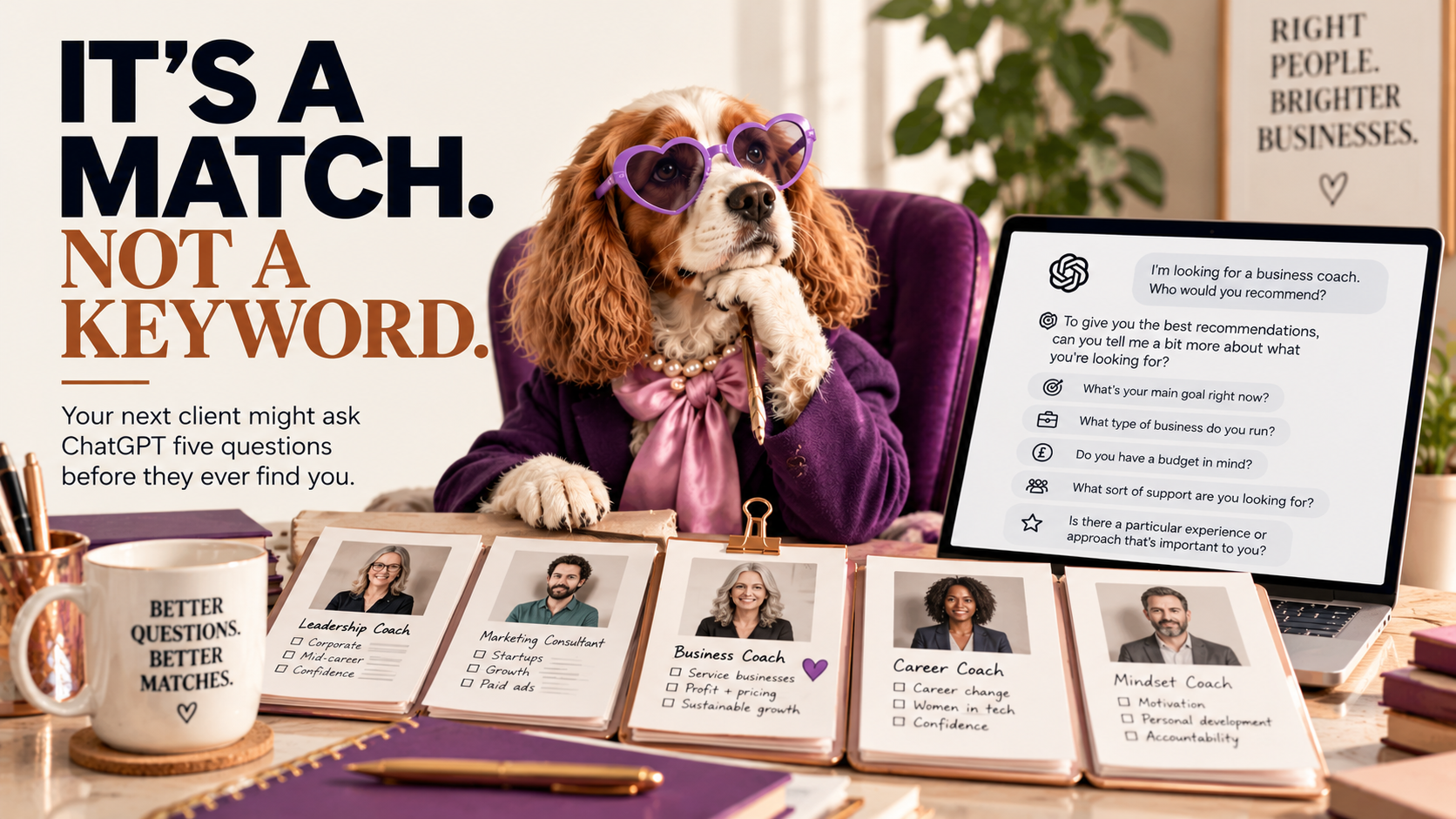
New research reveals something interesting about how ChatGPT makes recommendations. And it could change how you think about getting found online.
Imagine someone is looking for a business coach like you.
They open ChatGPT and type:
“I’m looking for a business coach – who would you recommend?”
You might imagine that ChatGPT would produce a list of five names, the person picks one, and that’s the end of that story.
But think about how you’d actually choose someone to work with if you were doing that independent research the “old way” on Google.
You wouldn’t necessarily hire the first person whose name appeared on a list.
You’d want to know whether they understood your situation. Whether they’d worked with people like you. Whether their approach suited you. And, of course, whether you could afford them.
You’d probably dive deep into their website, read their blogs, listen to a podcast or two, download their freebie and maybe even ask a few more questions on a discovery call.
And that’s exactly why some fascinating new research caught my attention.
ChatGPT isn’t always jumping straight to the recommendation
In October 2026, an AI research company Rankscale published a study looking at how ChatGPT responds when people ask for buying recommendations.
The researchers examined 7,313 responses to 765 different buying prompts across the UK, US and Germany.
And this is the bit that caught my eye in particular.
In 79.4% of those responses, ChatGPT presented follow-up questions to help narrow down the recommendation.
Rather than just producing a boring AF list of 5, it asked for more information.
For example, if you’re the type of person who goes running (!) and were looking for running shoes, you might be asked:
- What’s your budget?
- Where will you be running?
- Are you a beginner or experienced runner?
- Is comfort or performance more important?
Someone looking for a laptop would get different questions. Someone choosing software for their business would get different questions again.
The questions changed depending on what the person needed.
Now, this particular research focused on buying products and services across a range of categories. It wasn’t specifically a study of people hiring coaches or consultants.
But it highlights something important about the way AI-assisted buying decisions can work.
The first question is only the beginning.
Now imagine that conversation is about your business
Let’s go back to our person looking for a business coach.
Their first question might be:
“Can you recommend a business coach?”
That’s incredibly broad and is probably going to give you names like Tony Robbins and Marie Forleo.
There are thousands of business coaches – and the right person for a brand-new entrepreneur taking baby steps into the big, bad world of online business might be completely wrong for someone who’s been running a consultancy for fifteen years and doesn’t need their hand held setting up an Instagram account or setting up an autoresponder to deliver a freebie.
So the conversation could develop.
“I’m self-employed and have been in business for about ten years.”
“I don’t want someone who’ll tell me to post on Instagram every day.”
“I need help making my business more profitable without working longer hours.”
“I’d prefer someone who’s worked with experienced women running service businesses.”
Suddenly, we’re looking for someone quite specific.
Not just a business coach.
A business coach who understands established service businesses, sustainable growth, profitability and the particular challenges of experienced female business owners.
And that’s when we start looking at a very different recommendation.
The coach who wasn’t particularly relevant to that first, very broad question might be an excellent match by the fourth.
That’s the opportunity I think more independent experts should be paying attention to.
You don’t need to be the answer to everybody’s question
For years, we’ve been encouraged to think about being found online in terms of keywords and rankings.
If you were a business coach, you wanted to appear when someone searched for “business coach”.
If you were a copywriter, you wanted to rank for “copywriting services”.
And if you weren’t featuring neatly on page one of Google then you worried that nobody would ever find you.
But these conversations happening within AI are not the same as a traditional search.
The person asking the question can explain what they really need – and have a side serving of moaning about the minutiae of their morning – I know you hear me out there ladies!
They can add context.
They can reject suggestions that don’t feel right – I know I get a gut feeling sometimes when I look at a website and nope my way right out of there via the back button.
They can ask for someone with particular experience, a different approach or a more suitable service.
Being the best match for the right person can matter more than being a general suggestion for everybody.
And for experienced independent professionals, that’s potentially very good news.
You haven’t spent twenty years becoming excellent at absolutely everything – and you know BS when you smell it so anyone claiming that they are indeed an expert at absolutely everything is going to set your spidey senses off – but, you’ve developed particular strengths (calm down there Liam Neeson, man!). You’ve worked with certain types of clients. You’ve discovered which problems you’re especially good at solving.
And that distinction definitely matters.
In fact, they’re often exactly why your best clients choose you.
They found something else interesting: the questions aren’t always the same (like, du-uh!)
Rankscale also discovered that ChatGPT didn’t consistently ask identical questions, even when researchers repeated the same initial request.
Across repeated tests, the same set of question types appeared only 37.2% of the time.
In other words, even an identical starting question could lead to different routes through the buying process.
That’s worth remembering when you see people sharing screenshots of ChatGPT recommendations.
Someone types “Who’s the best business coach?”, takes a screenshot of the answer and decides they’ve either won or lost the AI visibility game.
But one response is just one response.
Change the wording, add some context or ask a follow-up question, and the recommendations change.
This doesn’t mean every conversation will produce completely different names. Nor does it mean AI will always ask clarifying questions.
It simply means a single screenshot doesn’t tell you the whole story.
And it certainly doesn’t tell you whether your business would be considered when someone describes the exact problem you’re brilliant at solving.
So what does this mean for your website?
Right, let’s get practical.
Imagine you’re a leadership coach who specialises in helping women move into senior management positions.
Your website says:
“I help you unlock your potential and become the best version of yourself.”
Lovely sentiment. Cute.
Unfortunately – it could describe approximately half the coaching industry and I think the ICF must dish it out in their welcome packs…
Now picture your website saying:
“I work with experienced women who are moving into senior leadership roles, helping them build confidence, manage difficult workplace relationships and lead teams without feeling they have to become someone else.”
That’s much more useful.
A prospective client can immediately understand whether you’re right for them.
And an AI system researching potential coaches has more specific information to work with.
It can identify:
Who you work with.
What stage they’re at.
What challenges you help them overcome.
What makes your approach relevant to their situation.
That doesn’t guarantee ChatGPT will recommend you. AI recommendations depend on many things – including which information the system can actually access and verify.
But if your website never explains those details in the first place, you’re making it harder for both people and machines to understand where you fit.
You might already have the answers. They’re just not on your website.
This is something I see a lot with experienced professionals.
You know your clients incredibly well.
If we sat down for coffee (large Colombian please! ☕) – I bet you could probably spend an hour telling me about the people you love working with, the problems they bring to you and the results they’re hoping for.
You’d explain which clients are a wonderful fit and which ones would be better served by somebody else – and it’s not even always about a you-them solution fit.
But when you sit down to write your website – all of that valuable detail somehow turns into:
“Empowering individuals to achieve transformational success.”
We’ve all seen it.
And I’m fairly sure nobody has ever walked into a coffee shop and said, “I’d like a transformational empowerment experience, please.” 😂
As always, the devil – and your real expertise lies in the details.
The stories, situations, specialisms and experience that make someone say, “Oh! That’s exactly what I need.”
Those are the things worth making clear online to both your potential clients – and AI machines.
Three things you can do today
You don’t need to rebuild your website or learn a new AI tool – praise the Lord – who can even keep up with a new “everyone’s favourite tool” on a weekly basis?
Start with three simple questions.
1. Who are you genuinely brilliant at helping?
Not everyone who could theoretically buy your services.
Think about the clients who get the most value from working with you. What do they have in common? What stage are they at? What makes their situation different?
2. What would someone ask to find a person like you?
Imagine a potential client explaining their problem to a knowledgeable friend.
What would they say?
Perhaps it’s “I need an accountant who understands small creative businesses” rather than simply “I need an accountant”.
Or “I want a career coach who works with women returning to work after a long break”.
The details change the question.
3. Does your website actually answer those questions?
Read your homepage and service pages.
Could a complete stranger work out who you’re best suited to help?
It was once said to me that your message must be clear enough that a 12 year old can understand.
Could they understand your experience, your approach and the specific problems you solve?
Or would they have to book a discovery call to find out? Because who in their right minds is wasting time on a discovery call when the proposition was so bloody vague they’re not even sure what they’re going to be talking about? 🤷
If the important details are missing, that’s a pretty good place to start.
The future isn’t about being recommended to everyone
One of the things I find most encouraging about AI-assisted research is the possibility of moving away from the endless competition for attention. No more battling it out for Google attention and keyword dominance.
Not every expert wants to build a personal brand around daily videos, constant posting and keeping an algorithm entertained.
Some people would quite like to get on with the work they’re actually good at.
Radical concept, I know. 😂
And while AI isn’t going to magically fix the way people find and choose businesses – it does introduce another way for potential clients to discover someone who fits their needs – and without all the drama of performing for the algorithm.
It’s bringing a quieter way to market – so you don’t need to be the loudest person out there, or the one with the biggest following – but instead, someone whose experience, services and approach make sense for the question being asked.
That’s why I believe it’s becoming increasingly important to make your business easy to understand.
Not just what you do.
Who you do it for, why you’re a good fit and when someone should choose you.
Because your next client might not find you through one search.
They might find you at the end of a conversation which started about cats, segued into a cycling holiday and finally started asking for you.
And, when they do – you want the information about your business to give them a good reason to take a closer look.
Research referenced: The Form Before the Answer: How ChatGPT Questions Buyers Before Recommending Anything, Mathias Ptacek, Rankscale, 21 October 2026.
At StructuredAF®, we help independent experts make the information about their businesses clearer and more consistent for AI and search systems, so those systems have a better basis for understanding what they do and who they help.