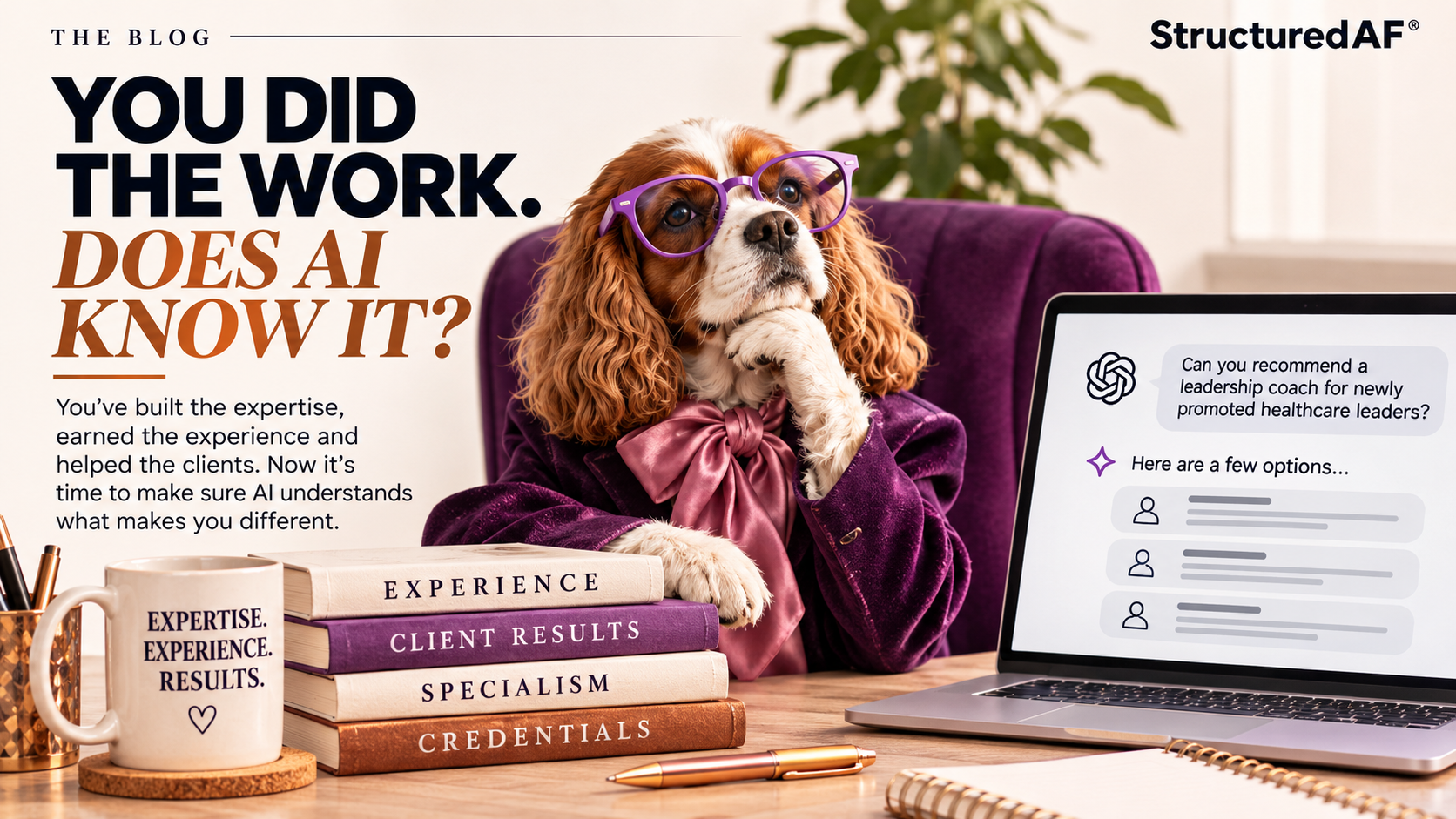
You Didn’t Spend Years Becoming an Expert Just to Be Overlooked by AI
Your experience is valuable. Your reputation is hard-earned. So why does AI sometimes struggle to understand what you actually do?
You didn’t become a coach, consultant or independent expert overnight.
You spent years learning your craft. Working with clients. Making mistakes. Getting better. Building the kind of knowledge that doesn’t come from a weekend certification or a beautifully designed Instagram carousel.
You know what you’re good at.
Your clients know what you’re good at.
But there’s a new question worth asking.
Does AI know?
Because the way people discover expertise is changing. And the information that helped someone find you five years ago might not be enough to help an AI assistant understand you today.
The problem isn’t your expertise. It’s how your expertise is represented.
Imagine someone asking ChatGPT:
“Can you recommend a business coach who works with women in their fifties who are starting businesses after leaving corporate careers?”
That’s a wonderfully specific request.
Not just a business coach. Not just someone who works with women.
Someone with a particular specialism, serving people at a particular stage of life, helping them solve a particular problem.
Now imagine that’s exactly what you do.
You’ve spent fifteen years helping women make that transition. You’ve worked with hundreds of clients. You have testimonials, qualifications and a brilliant understanding of the challenges they face.
But your website says:
“Empowering ambitious women to unlock their potential and create the life they deserve.”
Oh, darling.
That could describe approximately half the coaching industry.
The problem isn’t that you’re not qualified.
It’s that the information you’ve published doesn’t clearly communicate the very things that make you the right person for that client.
And when an AI system tries to identify suitable experts, those missing details can matter.
You shouldn’t have to become an entertainer to be recognised as an expert.
For years, we’ve been told that building a successful independent business means becoming increasingly visible.
Post more. Show up more. Make Reels. Start a podcast. Share your morning routine.
Apparently, having twenty years of professional experience isn’t enough unless you’re prepared to dance about it on Instagram.
And now we’re being told to optimise for AI, too.
Another platform. Another strategy. Another collection of acronyms.
But what if the answer isn’t producing more content?
What if it’s making better use of the expertise you’ve already spent years building?
Your existing website might already contain an enormous amount of valuable information.
Your services. Your background. Your specialisms. Your approach. Your client results.
The question is whether that information is clear, connected and accessible enough for machines to interpret accurately.
Because being present on the internet and being properly understood are two different things.
AI doesn’t need another performance. It needs clarity.
Let’s say you’re a leadership coach.
Your homepage introduces you as a transformational coach helping people achieve extraordinary results.
Your About page mentions that you spent eighteen years working in senior NHS management.
Your Services page explains that you specialise in helping newly promoted healthcare leaders manage difficult conversations and build confident teams.
Your testimonials describe how you’ve helped ward managers and clinical directors navigate challenging transitions.
That’s a valuable, distinctive professional identity.
But the pieces of information are scattered across different pages, expressed in different ways.
A human visitor might connect those dots.
An AI system might, too.
But why make either of them work harder than necessary?
A clearer website would explicitly connect your professional background, your specialism, your services and the people you help.
And behind the scenes, structured data can reinforce those relationships in a machine-readable format.
It’s not glamorous.
It doesn’t involve a secret prompt, a revolutionary algorithm or a £15,000 transformation programme.
It involves making your business easier to understand.
Which, frankly, should never have been quite so revolutionary.
The internet rewarded attention. AI rewards understanding.
For much of the internet’s history, businesses competed for clicks.
Search rankings. Social reach. Website traffic. Followers.
Those things haven’t disappeared, and they still matter.
But AI assistants introduce another way people can discover businesses.
Someone can describe a problem, explain what they need and ask for suitable options without knowing which businesses exist.
That creates an opportunity for independent experts.
You don’t necessarily need the biggest audience to be relevant to a highly specific request.
You need your expertise to be accurately represented, your specialisms to be clear and your claims to be supported.
Of course, AI recommendations aren’t guaranteed. Different systems use different sources and methods, and their answers can change.
But there’s a fundamental difference between trying to manipulate an AI system into mentioning you and making sure the information available about your business is accurate and useful.
One is chasing an algorithm.
The other is building a better representation of your expertise.
We know which one we’d rather spend our time doing.
Your website should do more than look professional.
A beautiful website is lovely.
But a beautiful website that doesn’t explain what makes you different is rather like turning up to a job interview in a fabulous outfit and refusing to answer any questions.
Presentation matters.
Substance matters more.
Your website should make it easy to establish who you are, what you do, who you help, what makes you qualified and how someone can work with you.
Those answers should be visible to people, not hidden exclusively in code.
Structured data can then help describe your business and connect relevant information in a consistent format.
It isn’t a magic switch that makes ChatGPT recommend you.
It’s one part of building a technically sound, clearly understood online presence.
And that foundation is worth getting right regardless of which AI platform becomes popular next.
You have already done the difficult part.
You’ve built the expertise.
You’ve done the work.
You’ve developed the judgement, experience and understanding that your clients value.
You shouldn’t have to reinvent yourself as a content creator, AI specialist or full-time marketer to communicate that value.
But you do need to make sure your website tells the truth about what makes you good at what you do.
Clearly. Specifically. Consistently.
Because somewhere, someone may be asking an AI assistant for exactly the kind of help you provide.
And your business deserves to be understandable enough to be considered.
You spent years becoming the expert. Your website should make that obvious.
Is your website giving AI enough information to recognise your business?
At StructuredAF, we help coaches, consultants and independent experts make their businesses easier for AI systems to understand through clearer business information and structured data.
Start with our free Website Check, a 12-point check of how clearly your homepage communicates your business.